
How to go on your first hike?
Partager
Sport & Wellness · Active Lifestyle
First hike: outfit, bag, and tips for a peaceful start
Dreaming of exploring trails but don't know where to begin? What to wear, what to pack, what distance, and how to stay covered without suffocating?
📅 Updated in 2026 🕐 8 min read 🥾 Sport & Wellness
Hiking is one of the most accessible activities there is. No need for expertise, no need for professional equipment, no need to already be athletic. Walk, observe, breathe — and along the way, contemplate what الله ﷻ has placed around us, which is good for both body and heart.
Choosing a truly easy hike!
The #1 mistake beginners make is aiming too high. You see a beautiful peak on Instagram, you think "alright, I'll do it", and you end up exhausted halfway with blisters.
For your very first outing, aim for between 4 and 8 km round trip, less than 300 meters of positive elevation gain, and a maximum of 2 to 3 hours. Choose a marked, well-trafficked trail, either a loop or a simple out-and-back, rated "easy" or "very easy" on specialized apps.
Apps like Visorando, Komoot, or AllTrails allow you to filter by difficulty, duration, and region. Be sure to read other hikers' reviews — they're the most reliable indicator of actual trail conditions.
The outfit: the 3-layer rule
This is the topic that causes the most hesitation. A classic hiking outfit shows your legs, clings to your body, or leaves your arms bare. And everything else — everyday leggings, long dresses, non-technical abayas — isn't designed for sweating or walking for 3 hours.
The 3-layer rule is the basis of any hiking outfit, to be adjusted according to the season.
Close-fitting, we look for breathability
Long-sleeved technical T-shirt. No cotton — it retains sweat and cools you down as soon as you stop. Opt for recycled polyester or merino, which dry quickly and don't absorb odors.
When it's cool, keep warm
Thin fleece or lightweight technical sweatshirt. You take it off as soon as you get warm, put it back on during breaks or at altitude. This is the layer you adjust most often throughout the day.
Wind and rain, anticipate
Lightweight windbreaker jacket, ideally water-repellent. It packs away into a ball at the bottom of your bag and saves you if the weather turns — which happens more often than one might think in mid-mountain areas.
For the bottom, opt for opaque sports leggings — truly opaque, test them in front of a mirror with light behind you before you go — loose enough not to hinder you on ascents. Over them, a long technical skirt-short or long sports shorts allows you to keep your silhouette covered without sacrificing freedom of movement.
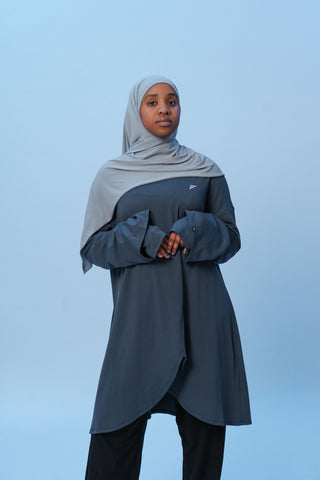
For the hijab, forget muslin and thick jerseys: they retain heat and stick as soon as you sweat. Opt for a breathable, quick-drying technical jersey in a light color if you're going out in direct sun, with an integrated cap or underscarf so you don't have to readjust it every 5 minutes.
What to pack in your bag
For a 3-hour outing, a 15 to 20-liter backpack is plenty. Here's the complete list of what to bring, without excess.
- Water: 1.5 L minimum, 2 L in summer
- Snacks: dried fruit, dates, cereal bar, banana
- Charged phone + lightweight power bank
- Offline downloaded itinerary (network coverage isn't always there)
- First-aid kit: bandages, anti-blister patches, disinfectant
- Sunscreen + lip balm + sunglasses
- Foldable mat or light towel for breaks and prayer
- Compass for qibla or your app — praying in nature, إن شاء الله an unforgettable moment
- Ziplock bags / trash bags to bring back your waste — respecting creation is part of our worship
- An extra layer in case it gets cooler than expected
The night before and the morning of departure
The peace of D-day is largely determined the night before. Packing your bag at 6 AM when you're already late is a sure way to forget something important.
The night before, check the weather — rain, wind, expected temperature at the maximum altitude of the route. Prepare your complete bag and weigh it if possible: less than 4 kg for a day trip is the goal. Charge your phone to 100%, download your itinerary offline, and go to bed early. Fatigue starts the day before.
In the morning, eat a proper breakfast — oats, dates, fruit, eggs. Not just coffee. Drink a large glass of water before leaving, tell someone your itinerary and expected return time, and leave early: the coolness, quiet trails, and leeway for delays are invaluable.
On the trail: 5 game-changing reflexes
Once you set foot on the trail, these five reflexes will make all the difference between a pleasant outing and an ordeal.
Start slowly, really slowly. The first 15 minutes should feel too easy. That's exactly the right pace.
Drink regularly, in small sips. Don't wait until you're thirsty — that's already a sign of mild dehydration.
Take short but frequent breaks. Five minutes every 45 minutes is better than one big 30-minute break that cools your body down.
Listen to your body, not your ego. If you're getting tired, slow down or turn back. The summit will always be there next time.
Look up. We often walk with our eyes fixed on our feet. Stop. Look. Breathe. Meditate on what الله ﷻ has created. That's precisely why you came.
أَفَلاَ يَنْظُرُونَ إِلَى الْإِبِلِ كَيْفَ خُلِقَتْ، وَإِلَى السَّمَاءِ كَيْفَ رُفِعَتْ، وَإِلَى الْجِبَالِ كَيْفَ نُصِبَتْ، وَإِلَى الْأَرْضِ كَيْفَ سُطِحَتْ
— Surah Al-Ghashiyah, verses 17 to 20
This verse invites us to observe creation — camels, the sky, mountains, the earth — as a path to knowing الله ﷻ. Hiking, without making it a religious act in itself, can become this moment of pure contemplation, provided you slow down and look.
What to really expect
Three things no one tells you before your first outing, and yet almost everyone experiences.
You're going to be sore the next day. Thighs, calves, sometimes shoulders from the bag. It's normal and will pass in 2 to 3 days. These are DOMS (Delayed Onset Muscle Soreness) from progress, not injury — your body is adapting to an effort it hasn't experienced before.
You might doubt yourself along the way. "Why am I doing this?" — all hikers think this at least once per outing, even the most experienced. Keep going. The reward almost always comes within the next 30 minutes: a panoramic view, a burst of sunshine on the ridge, a calming silence.
You'll want to go back. Statistically, this is what happens to 9 out of 10 women after their first successful hike. Welcome to the community.
And after? Progressing without burning out
Once your first hike is validated, you can progress steadily, without rushing and without performance pressure.
For your second outing, keep the same difficulty level but change the scenery: forest, lake, ridge. For the third, add about 1 km or 100 meters of elevation gain. By the fourth, you'll be able to try a "moderate" level hike lasting 4 to 5 hours.
The secret isn't intensity — it's consistency. And that's also a deeply Islamic principle.
أَحَبُّ الأَعْمَالِ إِلَى اللَّهِ أَدْوَمُهَا وَإِنْ قَلَّ
— Hadith reported by Al-Bukhari and Muslim
"The deeds most beloved to Allah are those done regularly, even if they are few"
This hadith applies to prayer, remembrance, reading the Quran — as it does to walking. A small hike once a week is better than a big one once every six months.
May الله ﷻ make movement easy for all of us, grant us bodily health, and make each of our outings a moment of well-being and contemplation of His creation.
أمين · وصلى الله على نبينا محمد وعلى آله وصحبه أجمعين
On the trail, with you
Whether you're preparing for your very first hike or are already a seasoned trail-lover, F.ACTIVEWEAR supports you with clothing designed for Muslim women on the move — without compromising on modesty, without compromising on performance.
Discover the collection →© Factivewear · Designed for women who hold onto their faith and their ambition.