
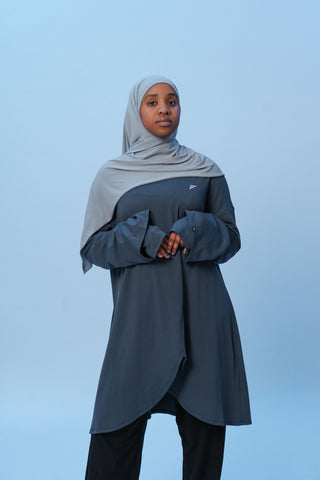
السَّلَامُ عَلَيْكُمْ my dear sisters — this will be a summary of the conditions of the veil as legislated by Allah, supported by sources from texts and sayings of scholars and not a personal opinion.
The elements mentioned in this article are systematically based on the Quran, the Sunnah, and the explanations of Sunnah scholars, in accordance with the understanding of the righteous predecessors. This is in no way a personal opinion.
Principles and purpose of the veil
The veil holds a central place in the religious practice of Muslim women. It is not merely an item of clothing, but a set of rules aimed at preserving modesty, dignity, and obedience to religious prescriptions.
This comprehensive approach allows for an understanding of the veil beyond fashion or cultural customs — to grasp its conditions and our duty to comply with them.
Preserving one's dignity and chastity in all circumstances
Submitting to Allah's commands with sincerity and conviction
An honor granted to the believing woman, not a constraint
An order inscribed in the Quran
The verse of the khimar — Surah An-Nur
“And tell the believing women to lower their gaze and guard their private parts and not expose their adornment except that which normally appears. And to draw their khimār over their bosoms…”
Surah An-Nur, verse 31“O Prophet, tell your wives and your daughters and the women of the believers to bring down over themselves [part] of their outer garments. That is more suitable that they should be known and not be abused.”
Surah Al-Ahzab, verse 59The 7 conditions of the legislated veil
Based on Quranic texts and hadiths, exegetes have established several essential criteria that every Muslim woman's garment must meet.
-
1
A covering and loose outfit
The veil must cover the body without outlining its shape. The outfit covers all parts of the body, with the exception of the face and hands according to the most widespread opinion.
Ibn Taymiyyah explains that the objective of the veil is to conceal the body's contours, not simply the skin. A tight garment, even if opaque, therefore does not fully fulfill its function.There will be women who are clothed but in reality naked… they will not enter Paradise.
— The Prophet ﷺ, reported by Muslim -
2
Absence of adornment and decoration
The veil should not be a source of adornment or attract men's attention. It should not become a means of beautification or visual provocation.
“And abide in your houses and do not display yourselves as [was] the display of the former times of ignorance…”
Surah Al-Ahzab, verse 33Sheikh Al-Albani explains that anything that intentionally draws attention contradicts the modesty required by Islamic law, whether it be through perfume, style, or excessive ornamentation. -
3
A thick and non-transparent fabric
The veil must be thick enough not to reveal the body. A fabric that allows the forms to be guessed at is considered a form of exposure.
An-Nawawi (Sharh Sahih Muslim) explains that these women are said to be “clothed” because they wear a garment, but “naked” because it is transparent, short, or tight. -
4
Not to be perfumed
It is forbidden for a woman to go out perfumed in a way that attracts men's attention, even to go to the mosque.
Any woman who perfumes herself and then goes out, passing by a group of people so they smell her perfume, is a fornicator.
— The Prophet ﷺ, reported by Abu Musa al-Ash'ariIf one of you comes to the mosque, she should not approach perfume.
— The Prophet ﷺ, reported by Muslim (Zaynab Al-Thaqafiyya) -
5
Not to imitate men
The Prophet ﷺ cursed men who wear women's clothing and women who wear men's clothing. This confirms the prohibition of resembling the opposite sex in one's attire.
Reported by Abu Hurayrah -
6
Not to imitate non-Muslims
The garment should not imitate styles specific to non-Muslims in their religious or cultural identity.
Whoever imitates a people is one of them.
— The Prophet ﷺ, reported by Abdullah ibn Omar -
7
Not to be a garment of fame (shuhrah)
Any garment worn for the purpose of being known or noticed — whether through luxury or false ostentatious frugality — is forbidden.
Whoever wears a garment that attracts attention (shuhrah) in this world, Allah will make him wear a garment of humiliation on the Day of Resurrection, and then that garment will be set ablaze.
— The Prophet ﷺ, reported by Ibn Omar
In Summary
The legislated veil in Islam is neither a simple cultural tradition nor a choice dictated by society. It constitutes an act of worship based on clear texts from the Quran and Sunnah.
Understanding the conditions of the veil allows us to move beyond superficial debates and return to the essential: worshipping Allah in accordance with what He has legislated, with wisdom, modesty, and sincerity.
The veil is not a constraint, but a protection and an honor granted to the believing woman. May Allah grant us beneficial knowledge, steadfastness in obedience, and sincerity in our actions. Amin
Covers the entire body without revealing its shape
Does not attract attention or men's gaze
Nothing can be seen through the fabric
No perceptible perfume in public
Does not resemble men or non-Muslims
No clothing of fame or show
Outfits designed to meet these conditions
At F.ACTIVEWEAR, each piece is designed to meet the criteria of the legislated veil: coverage, opacity, looseness, and sobriety.
Discover the store