
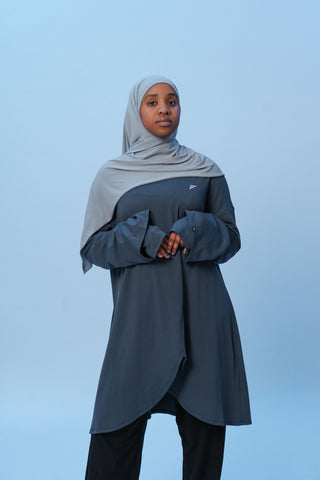
Good sportswear starts with the right material. Before the cut, before the color, even before the style: if the fabric doesn't wick away sweat, dry quickly, and follow your movements, no cut in the world will save your workout.
For modest practice—where more body surface is covered—the choice of fabric becomes even more crucial. This guide gives you the keys to choosing the right material, based on the real technical properties of fibers.
Why cotton is (wrongly) associated with sports
Cotton enjoys an extremely positive image: natural, soft, breathable, hypoallergenic. For decades, cotton t-shirts, sweats, and jogging suits have been the standard for sportswear. We've seen it on every field, in every gym, on every Sunday jog.
Three reasons explain why it is still spontaneously associated with sports:
-
1
Cultural heritage
Cotton is the textile of "old school" sports, from the 80s-90s, of Rocky, what you imagine wearing to sweat.
-
2
Initial sensation
When in contact with dry skin, cotton is soft and pleasant. A perception that completely reverses as soon as sweat comes into play.
-
3
The "natural = performance" shortcut
The association "natural = healthy = performance" is a frequent mental shortcut that does not stand up to technical analysis of textile properties.
Cotton is an excellent textile for daily wear and rest. But its intrinsic properties make it poorly suited for sustained physical exertion — and particularly unsuitable for covering attire.
What really happens when you sweat in cotton
A fabric that absorbs… but doesn't wick away
Cotton can absorb up to 27 times its weight in water — making it an excellent fabric for a bath towel, and a poor textile for a sports abaya.
Hydrophilic property of cellulosic fibersWhen you sweat, the fibers trap moisture against your skin instead of pushing it outwards. Result: the garment becomes heavy, waterlogged, and stays wet for hours.
Slow drying, and the "cold wet" effect
Cotton takes an extremely long time to dry. In an air-conditioned gym or outdoors after a workout, this phenomenon creates a sudden cooling of the body: this is the discomfort of a sticky, icy t-shirt once the effort is over.
Friction, irritation, and loss of shape
An soaked cotton becomes heavy and stiff. It rubs more against the skin, increasing the risk of chafing in the armpits, crotch, and friction areas. For modest attire that covers the arms to the wrists and the legs to the ankles, these friction zones multiply.
A breeding ground for bad odors
The moisture retained by cotton creates an ideal environment for bacterial proliferation — and thus for odors. This is one reason why a cotton sports T-shirt "smells strong" much faster than a technical equivalent.
In modest practice, where the fabric remains in prolonged contact with the skin over a large area, these drawbacks are amplified. A 100% cotton abaya drenched in sweat quickly becomes more of a constraint than a garment.
The true allies of sport: technical fabrics
The textile industry has developed a new generation of fibers designed specifically for performance. Here are those found in modern sportswear — and those we favor at F.ACTIVEWEAR.
-
1
Polyester
The standard for technical sportswear. Hydrophobic: it does not retain moisture; it wicks it away (wicking effect). Dries in minutes, lightweight, durable, retains its shape wash after wash.
Key property: polyester is hydrophobic — water does not penetrate the fiber. It slides to the fabric's surface and evaporates quickly. -
2
Polyamide (Nylon)
Softer and more durable than polyester. Silk-like feel, excellent tear resistance. Ideal for leggings, base layers, and close-fitting garments.
-
3
Elastane (Lycra / Spandex)
Never used alone, integrated at 5–20% in blends. It provides elasticity, shape retention, and support. Without elastane, there is no true freedom of movement.
Note: an elastane fiber can stretch up to 600% of its original length before returning to its initial shape. -
4
Merino wool
The premium natural alternative. Naturally antibacterial, thermoregulating, soft. Perfect for trail running, hiking, long-duration outdoor sports.
-
5
Bamboo / Tencel
Soft, biodegradable, naturally antibacterial plant fibers. Good breathability, exceptional feel. Ideal for yoga and gentle practices.
-
6
Recycled Polyester (rPET)
Same technical performance as virgin polyester, but made from recycled PET bottles. The modern answer to the dual demands of performance + environmental responsibility.
All our pieces are made from certified polyester / elastane blends — wicking, opacity, quick-drying.
View the collectionHow to recognize good sports textile
Beyond the composition label, here are the concrete criteria to check on a sports garment — especially when it comes to a covering piece:
| Criterion | What to look for |
|---|---|
| Moisture wicking | Mention wicking, dry-fit or moisture-wicking |
| Breathability | Mesh weave or openwork inserts on hot zones |
| Grammage | 140–180 g/m² for a top, denser for compression leggings |
| Elasticity | Immediate return to original shape after stretching (4-way stretch) |
| Seams | Flat, heat-sealed or folded — no overlocking that rubs |
| Opacity | The fabric must remain opaque even when wet and in motion |
Stretch the fabric and pass your hand behind it: if you see your skin or leggings through it, the garment will not fulfill its promise of coverage during exercise.
Critical in modest sport — essential to test before purchaseAll our fabrics are opacity tested. La Randonneuse is coming soon — sign up to be notified.
Get notifiedWhy it's even more important in modest practice
When dressing modestly for sports, you cover more body surface: full arms, full legs, torso, and often the head.
This means two things from a textile perspective:
More fabric in contact with the skin = more sweat to wick away. Choosing a material that actively manages moisture is no longer a comfort; it's a necessity.
— Fundamental principle of modest sport✓ What to look for
- Breathable polyester / elastane blend
- Loose fit that allows air circulation
- Opacity maintained in motion and when wet
- Sleeves that don't ride up, hems that stay put
- Quick drying between sessions
- Soft fabric that doesn't scratch the forearm
✗ What to avoid
- 100% cotton (absorbs and retains moisture)
- Thick fabric that retains heat
- Transparency as soon as you raise your arm
- Sleeves that are too short or too tight
- Tight fit that accentuates body shape
- Protruding seams in the armpits
F.ACTIVEWEAR ticks all the ✓ boxes. Discover pieces designed for modest sport.
View selectionThe F.ACTIVEWEAR selection
At F.ACTIVEWEAR, we have made a deliberate editorial choice: not to offer 100% cotton sportswear. Not by dogma, but because our commitment is to deliver pieces that live up to their promises on the field.
You deserve a garment that supports you in your effort, not one that suffers it. Each piece is designed in a calibrated technical blend according to its use: breathability, maintained opacity, quick drying, and total freedom of movement.
The Versatile
Fluid technical fabric, active sweat wicking, opacity maintained in all circumstances.
View product →The Gymnast
Oversized double-sleeve — designed for extensive movement without riding up. Ideal for gym and CrossFit.
View product →The Hiker
Technical skirt-pants — the alliance of a covering skirt and sports shorts for trail and hiking.
View product →Sport Hijab
Breathable mesh polyester — anti-slip, quick-drying, adjustable size 52–63 cm.
View product →In summary
Fabric choice is the first decision to make before any modest sportswear purchase.
Moisture is transported to the outside of the fabric, not retained against the skin
Coverage holds even during intense effort and with wet fabric
Ready for the next session without waiting hours
Total freedom in all axes of movement
Flat seams that do not create irritation during long sessions
Retains its shape and technical properties wash after wash
Ready to switch to materials that truly support you?
Explore the F.ACTIVEWEAR collection: technical fabrics selected for modest sport, without compromising on modesty or performance.